
Samsung and POSTECH unveil breakthrough in 2D/3D switchable display technology
Samsung and POSTECH have made a significant advancement in display technology by developing a switchable 2D/3D display using metasurface lenticular lenses. This breakthrough could transform next-generation displays in various devices.

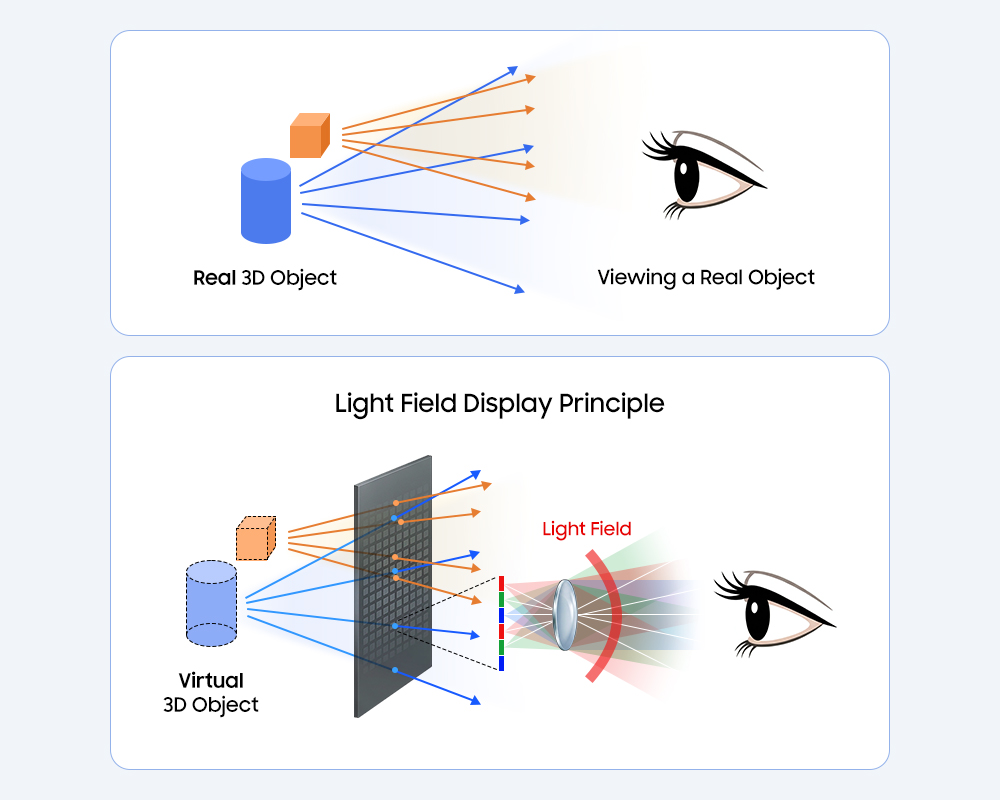
Samsung Electronics, in collaboration with Pohang University of Science and Technology (POSTECH), has published a groundbreaking research paper titled “Switchable 2D-3D display through a metasurface lenticular lens” in the esteemed journal Nature. This publication marks a significant advancement in the field of next-generation display technology, achieved through a synergistic partnership between industry and academia.
The research introduces a revolutionary approach to 3D displays using metasurfaces. A metasurface lenticular lens-based switchable 2D/3D display employs an ultra-thin metalens, which is constructed from nanoscale structures, to seamlessly transition between flat (2D) and stereoscopic (3D) images. Metasurfaces, known for their thin profiles and complex optical capabilities, are integral to the development of future display and camera systems.
This innovative system enhances Light Field Display technology by directing light from multiple angles, offering a glasses-free 3D experience that closely mimics natural perception. Although Light Field Displays have shown potential in entertainment, augmented reality (AR), and medical imaging, they face challenges in commercialization due to bulky optics, limited viewing angles, reduced resolution, and dependency on real-time eye tracking.
The research team addressed these obstacles by utilizing polarization, which refers to the direction of light oscillation, to design a metasurface lenticular lens (MLL) that dynamically adjusts its focal properties. This breakthrough enables the first demonstration of a meta-optical system capable of switching between 2D and 3D modes in a single device using voltage control. This development allows users to select between high-resolution 2D for routine tasks and immersive, multi-view 3D for video content.
The system operates by switching the metalens between concave and convex modes, depending on the state of the polarization controller in front of the display. For 2D applications, such as reading or browsing, the metalens functions as a concave lens, allowing light to pass through like a flat pane of glass, producing a clear image. In contrast, for 3D content, the metalens becomes convex, working with the existing lens to enhance depth and broaden the viewing angle, providing simultaneous clarity and depth.
A notable achievement of this research is the significant improvement in both the thickness and viewing angle of the device. Traditionally, achieving high image quality and wide viewing angles required large, thick lenses. However, the team’s MLL features a high numerical aperture (NA), resulting in an ultra-thin profile of 1.2 mm and an ultra-wide viewing angle of up to 100 degrees. This represents a more than sixfold increase from the conventional 15-degree viewing angle, allowing multiple viewers to experience 3D content from various positions.
The research goes beyond a simple proof of concept, demonstrating the practical viability of integrating metalens technology into real-world devices. The team successfully fabricated a large-area metalens measuring 50 × 50 mm (25 cm²) and validated its application on OLED panels commonly used in mobile devices. This project was conducted in collaboration with Samsung Research’s Visual Technology Team, Samsung Electronics, and POSTECH’s Nanoscale Photonics & Integrated Manufacturing Laboratory.
Looking forward, this technology holds the potential to transform next-generation displays across smartphones, tablets, and commercial systems. Through advancements in optical design, fabrication, and real-time switching validation, Samsung and POSTECH have overcome a significant technological barrier. With this publication in Nature, Samsung further cements its leadership in meta-optics and next-generation display technologies.