
Exploring Samsung’s journey in developing glasses-free 3D displays
Samsung Electronics has introduced Spatial Signage, a glasses-free 3D display, at ISE 2026. This innovation, developed through collaboration across various teams, offers immersive 3D experiences without the need for glasses.

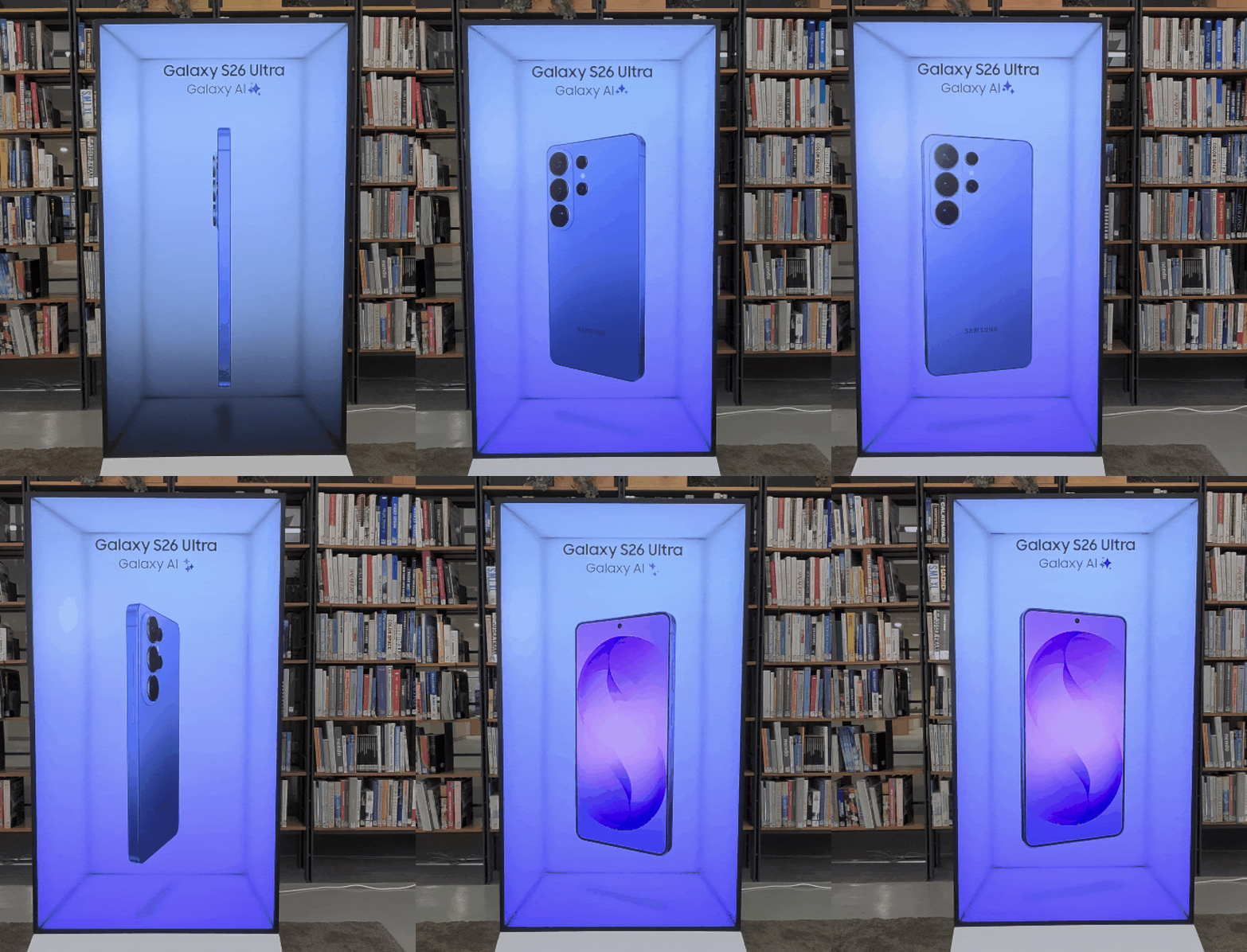
At the Integrated Systems Europe (ISE) 2026, held in Barcelona this past February, Samsung Electronics unveiled a groundbreaking installation that captivated attendees. The display, a mere 52 mm in thickness, showcased objects seemingly floating in midair, rotating 360 degrees without the need for 3D glasses.
Known as Spatial Signage, Samsung’s glasses-free 3D display has garnered industry accolades, securing awards at IFA 2025, CES 2026, and ISE 2026. The development of this innovative technology was a collaborative effort involving Samsung’s display, research, and design teams, each addressing unique challenges in the creation of 3D visuals.
Samsung Newsroom engaged with company experts, including Jong-Gu Sun and Yujin Nam from the Visual Display Business, Chang-Kun Lee from Samsung Research, and Eun Vit Chung from the Corporate Design Office, to discuss the journey behind this innovation.
With an increasing demand for distinctive visual content, the need for advanced display solutions is rising. “We are observing a growing interest in visually compelling content that captures attention, such as ultra-large LED-based anamorphic displays,” noted Sun. “However, these typically require more space and dedicated 3D content.”
“Spatial Signage offers immersive 3D depth without glasses or cumbersome holographic setups, enabling unique experiences across various environments,” he added. “It also reduces the cost of creating dedicated content while being compatible with existing signage systems.”
Central to Spatial Signage is 3D plate technology. “The system uses optical components to send separate images to each eye, leveraging binocular disparity to create depth perception,” explained Lee. “A lenticular card, which shows different images based on the viewing angle, is a common example of this technology.”
Developing an ultra-large 85-inch 3D display presented challenges, as the 3D plate combines lenticular lenses with printed images to produce 3D visuals. “If discrepancies exist between the design specifications and the actual structure, the background can appear distorted,” Lee noted. To tackle this, a special pattern was developed to detect errors during lens production.
Another challenge was securing depth while maintaining a slim profile. Spatial Signage uses a thin 3-4 mm 3D plate to create a perceived depth of up to 500 mm. “Achieving depth with such thin materials made lens design and reliability testing challenging,” Nam explained.
In addition to technological achievements, designing an intuitive and immersive visual experience was crucial. “To maximize depth on the 85-inch screen, we refined the 3D plate imagery and developed guidelines for image processing,” Chung emphasized. This involved precisely calculated lines and surfaces, along with lighting and shadows that align with the background’s depth.
Spatial Signage opens new possibilities for B2B displays, with plans to expand its lineup beyond the current 85-inch model to include 32-inch and 55-inch options. “Whenever I see Spatial Signage in a café, people pause to admire the display,” said Nam, highlighting its potential for engaging promotional content.
Samsung’s AI Studio, part of the Visual eXperience Transformation (VXT), allows users to create signage-ready videos from a single product image, further enhancing the immersive experience offered by Spatial Signage.
Ultimately, Spatial Signage represents more than just 3D imagery; it aims to create immediate, memorable, and lifelike experiences in everyday settings.