
Samsung’s spatial signage transforms Everland’s queue into an immersive safari experience
Samsung’s Spatial Signage at Everland’s Safari World transforms the queue into an immersive 3D experience, enhancing visitor anticipation and engagement with realistic animal displays.

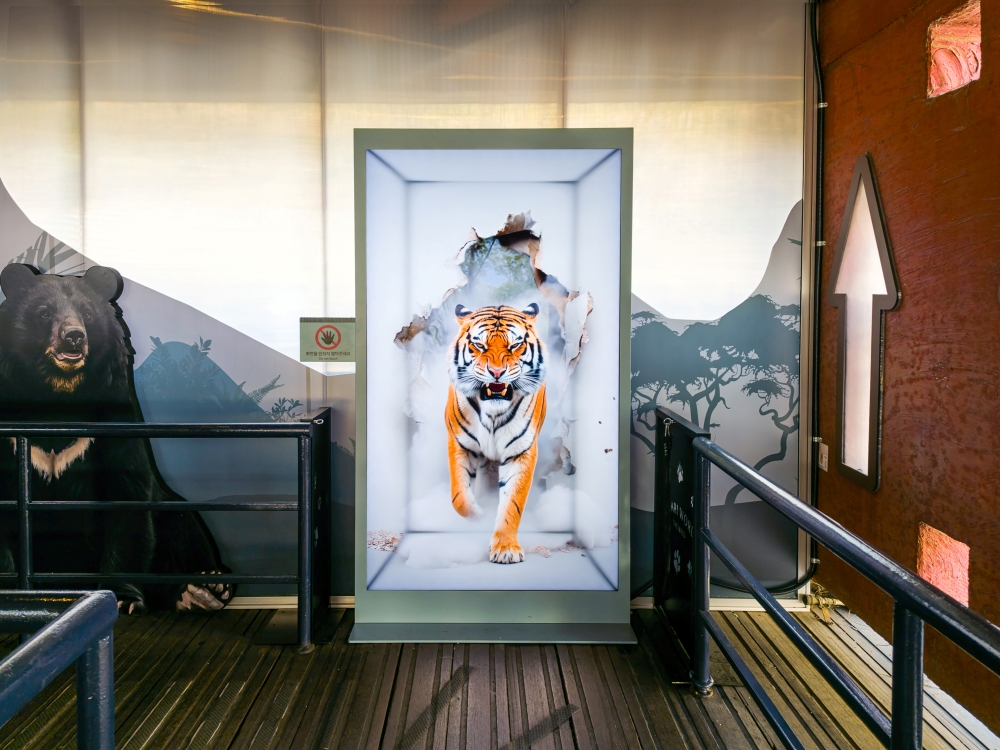
Visitors to ‘Safari World: The Wild’ at Everland, South Korea’s largest theme park located in Yongin, Gyeonggi Province, are treated to an unexpected surprise while waiting in line. Thanks to Samsung’s innovative display technology, realistic images of tigers and lions appear on a large screen, seemingly ready to leap into the crowd, enhancing the anticipation for the safari adventure.
Samsung Electronics recently introduced its glasses-free 3D display, known as Spatial Signage, at the revamped Safari World in Everland. This technology uses Samsung’s proprietary 3D Plate technology to deliver remarkable depth and realism without the need for 3D glasses, all within a slim 52-millimeter frame.
During a visit to Everland, Samsung Newsroom explored how Spatial Signage enhances the waiting experience and gathered visitor reactions to this immersive technology.
Spatial Signage sets the stage for a safari adventure by bringing animals to life even before the tour begins. The vivid movement and three-dimensional effects on the screen intensify the sense of immersion, building excitement for the upcoming journey.
“Following Safari World’s transformation into an ecological space with a focus on animal welfare, we aimed to unify the guest experience from entry to the safari bus ride,” explained Jiyeon Bae, Leader of Partnership & Alliance Group at Samsung C&T. “Spatial Signage was the ideal solution to guide guests into the safari adventure.”
Bae further elaborated, “To evoke the atmosphere of a wild expedition, we installed large animal artworks along the waiting route. By extending this experience through Spatial Signage, we enhanced visitors’ immersion with vivid, life-sized animal visuals.”
The 85-inch display’s installation was carefully considered. “We designed a custom frame that seamlessly integrates with Safari World’s atmosphere,” Bae noted, “allowing the display to fit naturally within the queue area.”
Visitors, particularly children, are captivated by the animals on screen, making the wait enjoyable and interactive, as they take photos and engage with the display. “Spatial Signage offers a preview of the animals before boarding the safari bus,” Bae added. “Children’s excitement is evident when they spot a bear or lion on the screen.”
Visitor feedback has been overwhelmingly positive. The glasses-free 3D experience transforms the waiting area into an engaging space where people interact with the display, capturing photos and enjoying the wait as part of the adventure.
One visitor commented, “It felt like real animals were in front of us. Taking photos with the kids while waiting made the time pass quickly.” A student on a field trip remarked, “I thought 3D required glasses, but the tiger looked so real when it seemed to jump out of the screen.”
Couples and tourists alike found the experience enriching, noting how the display heightened their anticipation for the safari. “The tigers, lions, and bears look so real, making the wait more enjoyable,” shared a group of tourists.
SeungHyuk Jin, CEO of Klleon, the company behind the content development for Spatial Signage, emphasized its role as an innovative interface. “Spatial Signage allows visitors to experience the space directly,” Jin said. “We focused on capturing the animals’ natural movements to immerse visitors in the safari world while waiting.”
At Everland’s Safari World, Samsung’s Spatial Signage not only enhances the identity of the space but also elevates the visitor experience. Samsung continues to lead in creating immersive display experiences across various settings.